A
Submission to the Beal Conjecture Competition
Last-Digit
Terminations and the Beal Conjecture:
An Explanation
By
Charles William Johnson
Before considering the Beal Conjecture below, we should
make a few remarks about Fermat's Last Theorem or conjecture, since
both of these conjectures are related. With regard to Fermat's Last
Theorem, the last-digit terminations determine the possibility of solutions
for that theorem. The stipulations of the equation cited by Fermat refer
to computations on a vertical plane for each particular
power (greater than two) of the natural numbers.
x n + y n = z n
The relation of equivalency concerns whole integers
for the terms and exponents greater than two (2).
There are no solutions to this equation as recently purported by Andrew
Wiles and other mathematicians in their study of elliptic curves and
modular forms.
However, there appears to be an easier method for obtaining a clear
proof of this equation and the absence of any relations of equivalency
as we have illustrated in different essays and extracts in the Earth/matriX
series (Cfr., Earth/matriX, Extract 38, 1999). One need only review
the exponents of n3, n4, n5, and n6 for the first ten natural numbers
in order to determine the fact that there are no solutions for this
theorem. The reason for this, is that the first ten numbers in relation
to the exponents of n3, n4, n5, and n6 produce a repeat pattern of last-digit
terminations for all natural numbers (1 to infinity) and for all exponents
(1 to infinity). Therefore, what holds true for the first ten numbers,
holds true for all numbers given the existence of the four patterns
of the last-digit terminations and the rules of simple addition.
In other essays and extracts, we have offered many examples of this
proof. However, we shall list a few examples here, merely to offer an
illustration of the patterns and their behavior according to the terms
of Fermat's Last Theorem. For a more detailed analysis, one should refer
to the various essays and extracts posted in the Earth/matriX series.
Last-Digit Terminations in Fermat's Last Theorem:
A Vertical Scroll of the Natural Numbers and Their Powers
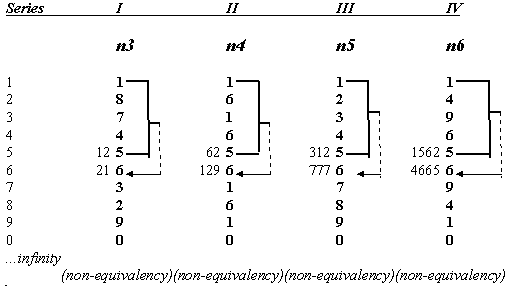
From the previous table, one may observe how it becomes
impossible, in adding numbers that end in a one (1) and a five (5),
to obtain a third product that ends in a six on the progression of natural
numbers and their exponents.
The Beal Conjecture represents a similar proposition, whose limiting
conditions makes it impossible to find a solution or relation of equivalency
for the terms of the equation. As stated, with regard to the Beal Conjecture,
if Ax +By = Cz , where
A, B, C, x, y and z are positive integers and x, y and z are all greater
than 2, then A, B and C must have a common factor, ...........
Charles William Johnson e-mail: johnson@earthmatrix.com
*************************
©1999-2015 Copyrighted by Charles William Johnson. All rights
reserved. reproduction prohibited.
THE GOLDBACH CONJECTURE AND THE UNIVERSE OF PRIMES |
|
Book:
THE GOLDBACH CONJECTURE AND THE UNIVERSE OF PRIMES
The Goldbach Conjecture and the Universe of Primes examines the even-sum
tables of the natural numbers and prime numbers in proving the conjecture.
The explanation of the inner workings of the Goldbach conjecture are rendered
into simple math. Knowing how to add is all that is required. Profusely
illustrated with easy-to-read math tables explaining how the sum of primes
perform in relation to the conjecture.
The author examines the Goldbach Conjecture, a 262 year-old conjecture.
It is impossible to prove the Goldbach Conjecture in the manner in which
the theorists of mathematics have been demanding. Instead of a resolution
based on algebra, an explanation of the Goldbach Conjecture based on the
numbers is required. In fact, this may be a simpler task than imagined
until now.
Purchase and download this Earth/matriX eBook
The Goldbach Conjecture and the Universe of Primes
Author: Charles William Johnson
Price $8.64 US |
 |
|
Link: The Beal Conjecture: Submission Number
Two
Earth/matriX
Science in Ancient Artwork and Science Today
Last-Digit Terminations and the Beal Conjecture: An Explanation
21 August 1999
©1999-2015 Copyrighted
by Charles William Johnson. All Rights Reserved
Earth/matriX,
Reproduction prohibited without written consent of the author.
|