|
Earth/matriX
SCIENCE IN ANCIENT ARTWORK
AND
SCIENCE TODAY SERIES
Essay Nº122
The Binary System
Charles William Johnson
Introduction
The binary system refers to the manner in which numbers are rendered for use in computers. Only two symbols (1, 0) are employed to write these numbers, with their positional notation determining their meaning. The binary system is written in a base two system.
The expression of the system is generally formulated in relation to the progression of powers. The progression of powers for the number two produces the progression of a constant number series:
21 = 2, 22 = 4, 23 = 8, 24 = 16, 25 = 32, 26 = 64, 27 = 128, 28 = 256, etc.
Using the binary system of notation, then, consider:
| 1101 = 1(23) + 1(22) + 0(2) + 1 |
= |
1(10) + 3 = 13 |
In other words, the foregoing means 8 + 4 + 0 + 1 = 13
The reason for the binary notation system concerns the nature of electricity in computer circuits. The presence of a zero (0) means that there is no electric current in the circuit, and the presence of a one (1) means that there is electric current in the circuit.
The binary system appears to be extremely elaborate and confusing, without any possibility of actually recognizing the numbers immediately. It is more of a case of observing the number (1101) and then computing it; especially when binary numbers appear such as 10011001 (#153), for example.
The predominance of computers obviously confirms the fact that the binary system works. Essentially it is a symbolic system of notation. Furthermore, it tells us something about the ancient reckoning system's method of computation. The ancient maya long count system runs parallel to the 1, 2, 4, 8, 16, 32, 64, 128, 256, 512... etc., series of numbers as we have explained throughout the Earth/matriX essays. Now, let us observe its similarity to the binary system.
**
The Binary System
The customary explanation of the binary system draws attention to the progression of the powers of the number two. However, as we analyze the base two system, we see that it actually begins with the number one (1), which breaks with the pattern of the powers of the number two. The pattern established by the progression of the powers of the number two implies that the first integer of the series would be the number two to the power of zero. This would mean that the first integer of the series should be a zero and not the number one. The expression calling the binary system a base two system seems to represent a misnomer. Therefore, the binary system actually reflects the progression of the number one (1) being doubled (duplatio/mediatio). In other words, the binary system is actually the 1, 2, 4, 8, 16, 32, 64...n., series, similar to the one used in the ancient reckoning system.
The notation is read from right to left, instead of the left to right system offered by the implied progression of powers. Instead of the notation based on powers, the translation of integers is more comprehensible when presented as follows:
| ... |
512 |
256 |
128 |
64 |
32 |
16 |
8 |
4 |
2 |
1 |
The binary notation signifies the presence/absence of either a one (1) or a zero (0), which represents the presence/absence of its corresponding figure on the previous progression of constant numbers.
| 128 | 64 | 32 | 16 | 8 | 4 | 2 | 1 |
| 1 | 0 | 0 | 1 |
1 | 0 | 0 | 1 | = | 153 |
In this case, the number 1 means that the numbers 128, 16, 8 and 1 are present, whose sum equals 153, while the zeros mean that the other numbers 64, 32, 4, and 2 are absent from the computation and are not taken into account. Therefore, in this case, the binary expression 10011001 represents the number 153.
One may visualize the numbers of the progression (2, 4, 8, 16...n) as of the progression of powers of the number two as we have seen, but this does not account for the integer one (1) that initiates the progression. The proper way to conceive of the progression of numbers for the binary system of notation is to simply think of the progression of the constant number one (1) being doubled subsequently to infinity. The number one is doubled, and its product is thereby doubled incessantly.
This may be better comprehended when we think of tripling the number one and forming another progression of constant numbers.
1, 3, 9, 27, 81, 243, 729, 2187...n
This progression results from an apparent three base system in relation to a progression of powers.
31 = 3, 32 = 9, 33 = 27, 34 = 81, 35 = 243, 36 = 729, 37 = 2187, 38 = 6561, etc. However, once again, the first integer of this proposed series, the number 1, would not comply with the established progression of powers.
In this sense another binary system could also be created, whereby the notation would be as follows:
| 2187 | 729 | 243 | 81 | 27 | 9 | 3 |
1 |
| 1 | 0 | 0 | 1 |
1 | 0 | 0 | 1 |
The same binary expression previously illustrated (10011001) would now signify the number 2296, given that the presence of 2187, 81, 27 1 yields the sum of 2296. In this manner the binary notation depends upon the numerical progression employed to define its terms. In other words, the definition of the meaning of the binary depends upon the underlying progression of constant numbers chosen.
The apparent reason for choosing the 1, 2, 4, 8, 16, 32, 64...n, series allows for expressing any number from zero up to (but not inclusive of) infinity. The progression based on the trebling of the number one (1, 3, 9, 27, 81...n) does not allow for the expression of all numbers through the addition of its elements. Notice, for example, how the numbers 2, 5, 6, 7, 8, 11, etc. cannot be obtained based upon the binary notation.
Consequently, various progressions of constant numbers could be construed in relation to the binary system of notation (1, 0). For example, one could multiply the number one (1) by three and, then double the remaining products/results:
1 x 3 = 3 x 2 = 6 x 2 = 12 x 2 = 24 x 2 = 48, etc.
This progression of constant numbers would therefore be as follows in relation to the same binary number (10011001) expressed above.
| 192 |
96 |
48 |
24 |
12 |
6 |
3 |
1 |
| 1 |
0 | 0 |
1 |
1 |
0 |
0 |
1 |
In this case, the binary expression, 10011001, now signifies in relation to this new progression of constant numbers, the sum of 229. In other words, the binary expression of a one or a zero (1, 0) may signify distinct computations depending upon their relationship to a chosen/given constant number series.
By assigning different values, then, to the binary notation (1, 0), distinct meanings could be assigned to a specific binary number as illustrated above; whereby 10011001 would repeat distinct figures:
| 10011001 |
= |
153 |
| 10011001 |
= |
2296 |
| 10011001 |
= |
229 |
Now, given the fact that the binary system in use today refers only to the 1, 2, 4, 8, 16, 32, 64...n series of constant numbers, the meaning of the binary number 10011001 is 153, and that is its meaning always. The other two options (2296 and 229) are simply inventions that we have constructed to illustrate how the assigning of values may vary. In other words, the binary system is an arbitrary system based upon the choice of a particular series of constant numbers. The choice of the 1, 2, 4, 8, 16, 32...n series is based upon the fact that it affords, given the design of the presence/absence procedure, offering a value (or binary number) for each of the natural numbers from zero to infinity.
In contemporary math, then, the binary notation is presented as only relating to the possibility of the constant number series 1, 2, 4, 8, 16, 32, 64...n, as we have seen. The ancient reckoning system appears to have devised a method of computation in relation to distinct (in fact, in relation to any) constant number series (1, 2, 4, 8, 16, 32, 64...n; 3, 6, 12, 24, 48, 96, 192, 384...n; 13, 26, 52, 104, 208...n; 9, 18, 36, 72, 144, 288, 576...n; etc.).
The ancient maya employed a system similar to today's binary system in the maya long count system, based on dots ( ), signifying one, dashes ( ), signifying one, dashes (  ), signifying five, and a shell-like shape signifying zero ( ), signifying five, and a shell-like shape signifying zero ( ), in relation to a distinct positional notation that yields similar results. The maya long count, however, consists of the 18c (36, 72, 144, 288, 576, 1152, 2304) progression in relation to the 1, 2, 4, 8, 16, 32...n, constant series, which formed the basis of the 360c calendar. Another count was based on the 13c (26, 52, 104...n) in relation to the same constant series, which formed the basis of the 260c calendar. ), in relation to a distinct positional notation that yields similar results. The maya long count, however, consists of the 18c (36, 72, 144, 288, 576, 1152, 2304) progression in relation to the 1, 2, 4, 8, 16, 32...n, constant series, which formed the basis of the 360c calendar. Another count was based on the 13c (26, 52, 104...n) in relation to the same constant series, which formed the basis of the 260c calendar.
The ancient computational procedure appears to have been extremely similar to the binary system. Both the binary system and the ancient maya long count system relate three distinct series of numbers.
|
|
|
...
576
288 |
|
|
| |
|
...
64
32 |
|
|
(1) |
144 |
| |
1, 0 | 16 |
|
(5) |
72 |
1- |
| | 8 | 1- |
|
(0) |
36
20
1 |
|
| |
4
2
1 |
The maya long count system also involves the 1,2,4,8,16,32,64,128...n series of constant numbers.
Consider the following values of the maya long count, in which the 1, 2, 4, 8, 16...n series is inherent.
| 8 | |
4 | |
2 | |
1 | | (x36) |
| 288 | 144 | 72 | 36 | | The natural number 9, then, would signify the sum of 8 + 1 (288 + 36 ) = 324. The 324 number would represent, in a sense, a binary like number based on the dot, dash, shell-like notation. |
Now, consider a change in values assigned when the constant series is changed:
| 12 | |
6 | |
3 | |
1 | | (x36) |
| 432 | 216 | 108 | 36 | | The natural number 9,then, would signify the sum of 6 + 3 (216 + 108 ) = 324. The 324 number would represent, in a sense, a binary like number. |
Now, a change in the count values in relation to these distinct constant series would change the values once again.
| 8 | |
4 | |
2 | |
1 | | (x26) |
| 208 | 104 | 52 | 26 | | |
| 9 = 234 (208 + 26) |
|
|
| 12 | |
6 | |
3 | |
1 | | (x26) |
| 312 | 156 | 78 | 26 | | |
| 9 = 234 (156 + 78) |
|
In this manner, we may observe how the values change for the different counts and constant series. The distinguishing point among these different options concerns the manner in which the sums of the numbers are divided. Within the same value system (26c or 36c), the results are the same 234 or 324, each in the order given, but the division of the values is distinct (208 + 26 or 156 + 78; and, 288 + 36 or 216 + 108). For example, the 288 + 36 procedure pertains to the maya long count system, while the 216 + 108 procedure is suggestive of the ancient kemi procedure and numbers. All of the above-cited numbers are historically significant. The different counts are easily related through the different constant series.
Were we to employ the constant series based on trebling (3x) the number one, the following would then obtain.
| 27 | |
9 | |
3 | |
1 | | (x36) |
| 972 | 324 | 108 | 36 | | |
|
|
|
Whereby 9 equals 324 on the 36c, and 9 equals 234 on the 26c. The ancients appear to have followed all of the above-cited procedures with the distinct counts and constant series, in relation to these and even other counts and other constant series alternatives. Today's binary system simply employs the constant number series (1, 2, 4, 8, 16...n) alone in relation to the positional notation (1, 0), which signifies presence or absence of the numbers from that series.
The Binary Notation
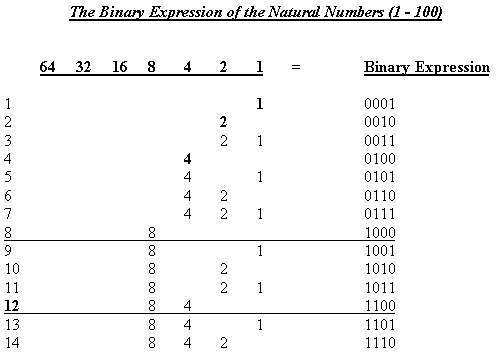
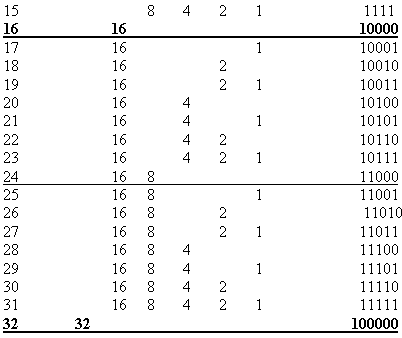
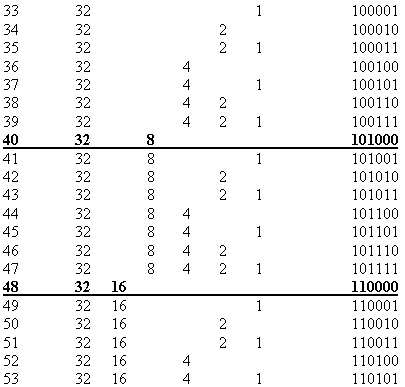
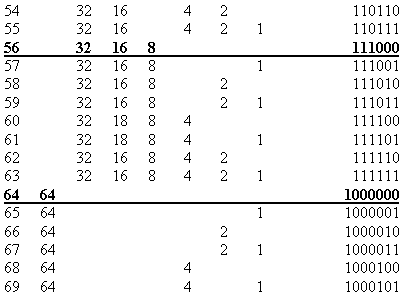
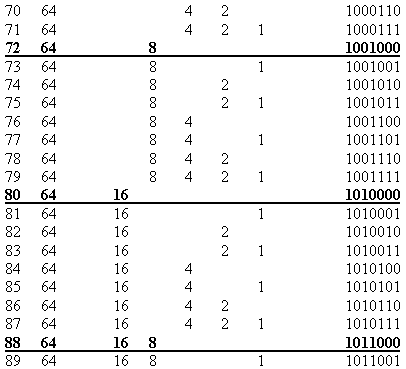
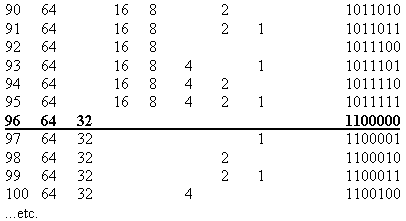
Let us list the natural numbers in their binary expression as of the constant series numbers. However, we shall not employ the progression of powers, but rather the products themselves for the table. This should offer us some insight as to the patterns established in the table of binary numbers.
For the purpose of visualization of the numbers, we shall offer only the presence of the numbers for a given binary expression. We shall eliminate the written zero, since it adds nothing to establishing the visual pattern. By presenting the constant numbers and the binary expressions in this manner, we should be able to form a better idea of how the progression of numbers develops. In fact, as we shall see, the pattern established even appears to be related to other number series, such as, the electron configuration count of the elements. It has often been said that the progression of numbers of the electron count represents a binary-like progression or system of numbers. Let us see how this unfolds from the point of view of the progression of natural numbers. We should remember that the progression of the atomic elements represents precisely that of the natural numbers depending on the number of elements considered (1 - 92, 1 - 96, or 1 - 105, 1-112, etc.).
Let us present the binary system of notation in relation to the constant number series 1, 2, 4, 8, 16, 32, 64...n, as occurs in the current usage of the system. In this regard there is one and only one way to express a particular number given the logic of the system. For example, when the lesser numbers are used and their sum equals another number on the series, as in 4 + 4, then one would employ the number 8 on the series; in other words, one cannot sum multiples of one of the numbers on the series. A constant number on the series may be employed only once in the formulation of a particular binary number, and therefore there exists only one way of expressing that number in its binary form. This feature of the 1, 2, 4, 8, 16, 32...n series is what makes it so unique in its symbolism in relation to the logic of the presence/absence of the binary system of notation. No other constant series offers this possibility for computing all numbers, one to infinity, other than the maya long count progression of 1, 20, 36, 72, 144, 288 fractal...n. In this regard it would be necessary to review the manner in which the 20-base maya system functions (Cfr., Earth/matriX essay number 1).
From the previous table, many different patterns become discernible. The main one concerns the termination for the first seven numbers.
| 1 | | | | 1 | 0001 |
| 2 | | | 2 | | 0010 |
| 3 | | | 2 | 1 | 0011 |
| 4 | | 4 | | | 0100 |
| 5 | | 4 | | 1 | 0101 |
| 6 | | 4 | 2 | | 0110 |
| 7 | | 4 | 2 | 1 | 0111 |
| 8 | 8 | | | | 1000 |
|
For the first seven numbers, the pattern is then repeated as of the number nine and repeats itself thereafter.
| 9 |
|
8 |
|
|
1 |
1001 |
| 10 | | 8 | | 2 | | 1010 |
| 11 | | 8 | | 2 | 1 | 1011 |
| 12 | | 8 | 4 | | | 1100 |
| 13 | | 8 | 4 | | 1 | 1101 |
| 14 | | 8 | 4 | 2 | | 1111 |
| 15 | | 8 | 4 | 2 | 1 | 0111 |
| 16 |
16 |
|
|
|
|
10000 |
|
Henceforth, another pattern repeats every 8th number: 8, 16, 24, 32, 40, 48, etc. The initial pattern, beginning with the number 1, then, repeats every 8th number as well, creating a changing progression of last digit numbers, with other patterns for each of the other endings:
Observations
The binary system of numbers obeys the needs of contemporary computers. The integers (1,0) obey the needs of electronic circuits. In this sense, the binary numbers based on these integers (1,0) are arbitrarily construed. The values assigned to the integers (1, 0), however, are in relation to the natural progression of numbers (1, 2, 4, 8, 16...n) based on the doubling (duplatio/mediatio, the ancient method) of the number one in an incessant and progressive manner. To identify the binary notation as of the progression of the powers of the number two (22), represents an inexact description of the progression of numbers (1, 2, 4, 8, 16, 32...n), since it does not account adequately for the initial number one (1) in the series.
The binary system of assigning either a 1 or a 0 to a given progression of numbers, essentially, follows the design of the ancient maya long count system. However, the maya long count system assigned the constant number series (1, 2, 4, 8, 16, 32...n) to the positional numbers of the maya long count itself, a distinctively chosen progression of numbers/fractals (1, 20, 36, 72, 144, 288, 576, 1152, 2304...n).
Distinct progressions of numbers exist which may be assigned and related to one another in different arrangements, thereby producing still other progressions of numbers, as we have examined above and throughout the Earth/matriX collection of essays. In utilizing distinct series of progressions of numbers, as shown above, different patterns would be produced as of the distinct tables. One could imagine the different patterns produced as of the numbers as serving a mathematical basis for the geometric designs of the fretwork in ancient art, as we have discussed in previous essays.
Given the fact that the binary system of notation is related to contemporary computers, its significance is viewed as being quite technical and advanced. By analyzing the functioning of the ancient reckoning systems, we have seen that the ancient system is essentially based on a similar system of notation as that of the binary notation. However, the ancient reckoning system appears to have employed many distinct progressions of numbers, and not only the 1,2,4,8,16,32,64,128...n series of constant numbers.
©199-2013 Copyrighted by Charles William Johnson. All rights reserved.
*************************
Your comments and suggestions are greatly appreciated:
e-mail:johnson@earthmatrix.com
Earth/matriX
Science in Ancient Artwork
The Binary System
Extract No.122
5 April 1999
Earth/matriX,
Reproduction prohibited without written consent of the author.
|