Critical and Creative Thinking The Theoretical Interpretation of Spacetime/motion

|

|

|

|

|

|
Collections of Books from Earth/matriX
By
Charles William Johnson
 |
EINSTEIN: MASS CONFUSION Read how the implicit formula designed into Einstein's famous equation predetermines the numerical results obtained are generally confusing or redundant. The confusion is clarified when using Planck mass and Planck energy in the equation. Below is a brief excerpt of this essay, but it is best to read the entire line of reasoning behind the distinction of Einstein's formula and Einstein's equation. They are in fact two different aspects of the same numerical values. The former has to due with a rigidity in the design of the E-term, energy, and the latter emphasizes the behavior of the numerical values in the relation of equivalency. |
||||||||||||
 |
THE PHYSICS CHALLENGE The physics paradigm today is based mainly upon the concept of c-square, the squaring of the speed of light in a vacuum. Numerous fundamental physical and chemical constants provided in the physics literature [CODATA] reflect numerical values based upon powers of c, the speed of light in vacuo. The speed of light in a vacuum is determined to represent the upper limit of movement of mass|energy by physicists. Yet, scientists carry this numerical value to higher powers of c, which have no material existence. The speed of light in a vacuum is employed in various fundamental physical constants. Generally, these different ideas in today’s physics paradigm are held without reservation among physicists. In fact, any critique of the physics paradigm is generally ignored or denied without explanation. In the author’s view, by defending the physics paradigm through denial, physics runs the risk of becoming in some regards a pseudoscience.
|
||||||||||||
 |
CODATA, PLANCK CONSTANTS, ERRORS AND OMISSIONS The author derives the Planck constants as of the fundamental physical constants, instead of as of the traditional symbolic formulae given in the CODATA. The implied numerical values that are generally omitted in the science literature and which serve as a basis for deriving the Planck constants are identified in detail in their basic math. As of the analysis of the implied Planck values, errors and omissions of the CODATA Planck values are identified and treated extensively. The Planck constants are reverse engineered in order to employ the fundamental physical constants as their computational foundation. Various Earth/matriX Tables of the Planck Constants Based on the Fundamental Physical Constants are presented for the first time, illustrating how the fundamental physical constants serve as the foundation to the Planck constants.
|
||||||||||||
 |
EVENTPOINT COSMOGEOGRAPHY Eventpoint Cosmogeography, a new study, opens up a distinct line of inquiry into the geography of the Earth. Charles William Johnson, from Earth/matriX, Science Today, questions the theory of continental drift by examining the distances between geographical extreme points and selected cosmogeographical event points. The translation and centrosymmetries of geographical coordinate points suggest the fact that the continents undergo movement, but that they have not drifted randomly on the face of the Earth for the past 250 million years as proposed by Alfred Wegener nearly a century ago. The symmetry between extremepoints and eventpoints illustrated in this study suggests that continental drift theory must be reconsidered, possibly abandoned.
|
||||||||||||
 |
THE SOUND OF MEANING: COMPARATIVE LINGUISTICS In the book Sounds, Symbols, and Meaning: Ancient Egyptian, Nahuatl and Maya, we examine the possible linguistic correspondences among these languages. Interestingly enough, one can identify ancient Egyptian in innumerable words of the Nahuatl language simply by dropping the letter "l" in the latter. Or, one may add the letter "l" to many ancient Egyptian words, and the similarity with Nahuatl becomes striking. Many words between ancient Egyptian and these Mesoamerican languages share a linguistic correspondence on three levels: phonemes, morphemes and even the symbolic or graphic (glyphs and hieroglyphs) level. We discuss the possibility of there having existed a Mesoamerican-Kemi proto-lingua possibly in the past, before these language groups were formed.
|
||||||||||||
 |
THE SOUND OF MEANING II: COMPARATIVE LINGUISTIC OF ANCIENT EGYPTIAN HIEROGLYPHS WITH TUNICA, CHITIMACHA AND ATAKAPA The Native American languages of Louisiana, Tunica, Chitimacha and Atakapa are compared to the ancient Egyptian hieroglyphs. Linguistic correspondences among these languages establish the possibility of contact at some point in ancient history among these cultures. This volume complements a previous comparative study between ancient Egyptian and the Maya language system as well as the language of the Aztecs, Nahuatl.
|
||||||||||||
|
THE TAINO LANGUAGE AND ANCIENT EGYPTIAN The Taino language is compared to the ancient Kemi-Egyptian hieroglyphs.This study complements other studies of the languages of the Americas in comparison to the ancient Egyptian hieroglyphs. The fact that numerous linguistic correspondences appear between the languages of the two separated hemispheres suggests a possible shared origin or common history.
|
||||||||||||
 |
ANCIENT EGYPTIAN AND PUREPECHA Ancient Egyptian and Purépecha represents volume five of the series of The Sound of Meaning. In this series of monographs we examine the linguistic correspondences between selected languages of the Americas and the ancient Kemi-Egyptian hieroglyphs. Purépecha is the language of the once referred to Tarascan peolpe of the highlands of Mexico. In this series we have compared Nahuatl, Maya, Taino, Atakapa, Tunica and Chitimacha languages to the ancient Egyptian hieroglyphs. Purchase and download eBook: |
||||||||||||
 |
PAKAL: THE ANCIENT ASTRONAUT In the book Pakal, the Ancient Astronaut, we explore the design elements of the Pakal sculpture found at Palenque, Mexico. We have analyzed and illustrated the design elements of the Pakal sculpture from the perspective of simple mechanics. We have given movement to the elements within the sculpture's image and in that manner see appear something that resembles a space craft. Obviously, such a rendering of the sculpture may be viewed critically, since from our knowledge about history, there is nothing in the historical record about the existence of spacecraft; at least, nothing specifically identified as such. However, in the visual rendering of Pakal's vehicle, a geometrical analysis seems to offer more of a solution to the enigma, than a semantic rendering of ancient texts.
|
||||||||||||
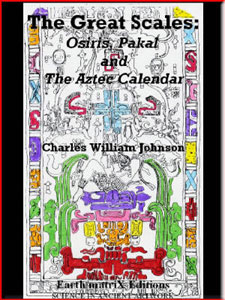 |
THE GREAT SCALES: OSIRIS AND PAKAL AND THE AZTEC CALENDAR In this essay, let us compare the elements of the belief system of Osiris with the design elements on the lid of Pakal's sarcophagus. Very little is known about the origin of the beliefs around Osiris of ancient Egypt. Therefore, a possible relationship between the Osiris belief system and the belief system of the ancient maya is not even considered to be a valid theme of research by many scholars. One cannot state that these two systems are related; there is no historical evidence to support such a thesis. But, we can compare the two systems to show how someone from the system of Osiris may have interpreted the elements on the lid of Pakal's sarcophagus.
|
||||||||||||
 |
ANCIENT NUMEROLOGY In Ancient Numerology, we examine different historically significant numbers, possible methods of computation, and some of the interrelationships of these numbers and methods. From all appearances, the different ancient reckoning systems suggest the possibility that they may have come from a single system of reckoning. |
||||||||||||
|
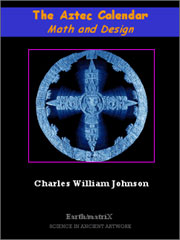
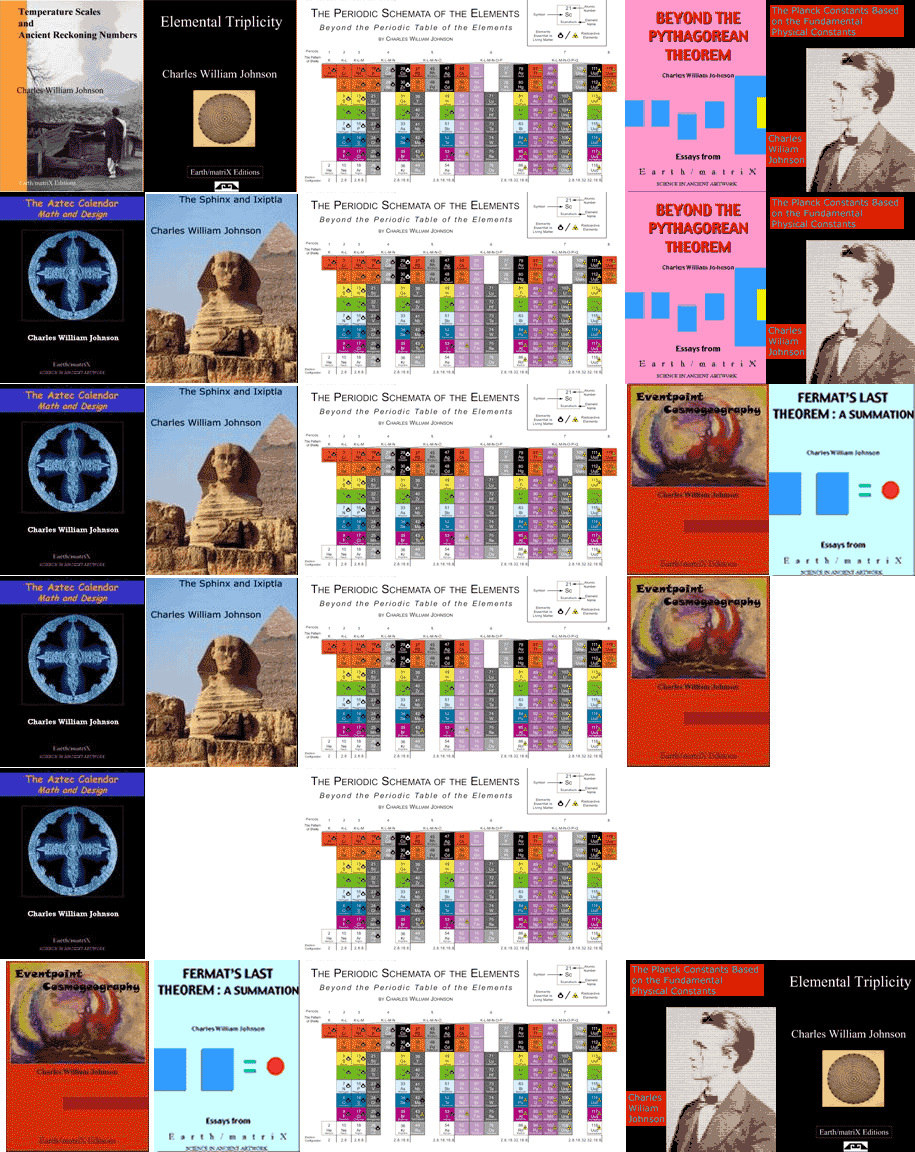
THE AZTEC CALENDAR: MATH AND DESIGN In the book The Aztec Calendar: Math and Design, Charles William Johnson examines the possible relationships between mathematics and geometry. The historically significant numbers may reflect progressions which in turn may be translated into geometrical figures and designs. No one knows for certain how the Aztec Calendar may have been read or interpreted. Its simbolic design is striking and has intrigued scholars for centuries. The Aztec Calendar: Math and Design explores the stone's elements and rings in relation to their spatial divisions in an attempt to discern a possible method of computation, using the historically significant numbers of the ancient reckoning system. The book promotes the existence of specific mathematical posits that the geometrical spatial division of the calendar's elements appear to obey.
|
|||||||||||||
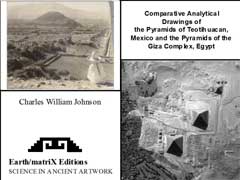 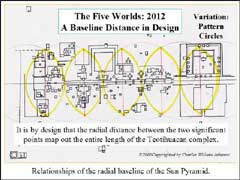 |
COMPARATIVE ANALYTICAL DRAWINGS OF THE PYRAMIDS OF TEOTIHUACAN, MEXICO AND THE PYRAMIDS OF THE GIZA COMPLEX, EGYPT "From my studies, it would appear that there exists a
sacred proportion employed in the ancient design of the pyramidal sites
around the world. In this case, the sites of the Giza Complex and that
of the pyramidal site at Teotihuacan, Mexico, both appear to share a
common, basic geometric design. The basic design appears to be based
on fractal proportions utilizing the side measurements of perfect right
triangles."
|
||||||||||||
 |
THE GOLDBACH CONJECTURE AND THE UNIVERSE OF PRIMES The Goldbach Conjecture and the Universe of Primes examines the even-sum tables of the natural numbers and prime numbers in proving the conjecture. The explanation of the inner workings of the Goldbach conjecture are rendered into simple math. Knowing how to add is all that is required. Profusely illustrated with easy-to-read math tables explaining how the sum of primes perform in relation to the conjecture.The author examines the Goldbach Conjecture, a 262 year-old conjecture. It is impossible to prove the Goldbach Conjecture in the manner in which the theorists of mathematics have been demanding. Instead of a resolution based on algebra, an explanation of the Goldbach Conjecture based on the numbers is required. In fact, this may be a simpler task than imagined until now.
|
||||||||||||
|
|
|||||||||||||
 |
PARTICLE MASS DIFFERENCE The author has chosen to explore the relationship between constants of proton mass (1.6726231) and neutron mass (1.6749286). The conditions of existence of the proton mass and the neutron mass are determined by, or themselves determine, the existence of packets of energy (certain quanta of energy). The differences between those numerical expressions are significant.
|
||||||||||||
 |
ELEMENTAL TRIPLICITY Elemental triplicity represents a grouping of different elements whose protonic and neutronic counts reflect the same/similar numbers reflecting a midpoint between two chosen elements, which defines a specific pattern of centro-symmetry. The middle element of the three elements chosen reflects the midpoint, or average of the two counts of the two extreme elements. Because the elements are typically not arranged according to the twenty-element baseline of the neutronic count, the relationships of elemental triplicity have never been visualized before, until now. The horizontal rows of eighteen elements on the conventional periodic table denies a visual rendering of the numbers of the elemental triplicities. The existence of groups of three ---or more--- elements with a pattern of centro-symmetry is populated throughout the elements, as illustrated in this book.
|
||||||||||||
 |
FRACTAL TRIANGLES:
|
||||||||||||
 |
TEMPERATURE SCALES AND ANCIENT RECKONING Ancient reckoning numbers reflect a historically significant fractal number of 1.366. The relationship between the boiling and freezing points of water is also a fractal expression of a 1.366 number. Random coincidence? The author thinks not. Different thermodynamic temperature scales based on unit one are derived and presented in an effort to overcome the incomparable and difficult to manage numbers of the existing temperature scales. Also learn what the square root of three has to do with the temperature scales and the boiling/freezing points of water. By assigning either the boiling or freezing points of water the unit 1.0, the different scales become easily comparable, and the gradation scales become relevant for other measurements such as the chemical and physical constants of matter-energy.
|
||||||||||||
 |
THE ELECTONIC AND NEUTRONIC SCHEMATA OF THE ELEMENTS he Electronic and Neutronic Schemata of the Elements is a full-color book with over 125 color illustrations of the new periodic table. The schemata of the elements are presented in selected versions of the electronic and neutronic configurations of the elements. The schemata represent a distinct re-structuring of the conventional periodic table. Color coded patterns of centrosymmetry, translation and reflective symmetry produce teaching and research aids for high school and college students. The selected compilation of electronic and neutronic schemata in this book represent only a few of the thousands of schemata now being produced by the Earth/matriX project. |
||||||||||||
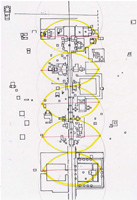 |
Comparative Analytical Drawings of the Aztec Calendar This 45-page work combines photos, drawings, and schematics to examine the art and science of the Aztec Calendar and the Pyramids of Teotihuacan. Excerpt: "The case may be that the Aztec Calendar may have functioned as a periodic table of the elements. In order to explore such a possibility, we must first compare the symbolism within the day-glyph ring on the face of the Aztec Sun Stone, in relation to the elements of matter-energy, as we know them today. It would appear that the Aztec Calendar kept cosmological time of the Universe. Besides measuring the Cosmic cycles, the Aztec Calendar may measured the minute world of the elements and their atoms." |
||||||||||||
 |
IMAGES OF THE AZTEC
CALENDAR |
||||||||||||
You may also purchase some eBooks
from Earth/matriX Editions.
information: charlesjohnson@earthmatrix.com
| Home | Books | Forum | Links | Author |