Download and purchase eBook
first in Languages Series
Sound of Meaning: Ancient
Egyptian, Maya and Nahuatl
Author: Charles William Johnson
PDF file 172 pages
ISBN 0.9755482-04
Price: $13.52US

Purchase and download eBook
Comparative Linguidtic of Ancient Egyptian Hieroglyphs with Tunica
Author: Charles William Johnson
ISBN 1-58616-434-1
PDF file
Copyrighted 2006
172 Pages
Price: $8.64US
Purchase and download eBook:
Ancient Egyptian and Purepecha
Author: Charles William Johnson
2007 Copyrighted
PDF File 67 Pages
ISBN 1-58616-453-X
Price: $7.56US

THE AZTEC CALENDAR:
THE POINTER

|
At the center of the pointer of the Aztec Calendar there appears the face of Tonatiuh, the Sun. For this reason, the commonly-know Aztec Calendar has been identified as La piedra del sol, or the Sun Stone. We shall refer to the Aztec Calendar by its common name.
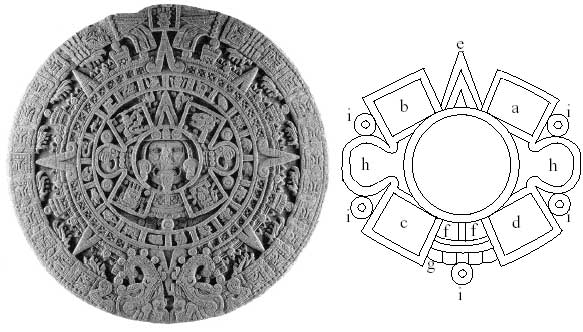 |
The Aztec Calendar's design is based on a set of concentric rings, divided into eight segments. The concentric ring around the fase of Tonatiuh consists of the Nahui Ollin, signifying 4 movement. The four square-like spaces contain the glyphs for a) Nahui Ocelot (4 Tiger); b) Nahui Ehecatl (4 Wind); c) Nahui Quiahuitl (4 Rain); and d) Nahui Atl or Atonatiuh (4 Water). Above Tonatiuh is a double lunar-solar ray (e).
Below Tonatiuh, we may also observe the breastplate with two quinounx (f) and five featherlike (g) figures, respectively representing the quantities of 52 and 104 (as well as other designated sums). The claw-like figures (h) on either side of the face are said to represent those of an eagle, clutching human hearts, possibly representing a sacrifice to the Sun. The reader should also note the five coordinate circles (i), which have also been identified as representing specific numerical quantities.
There is much debate about the significance of the elements in the pointer of the Aztec Calendar, as there is regarding almost all of the elements of the calendar itself. This brief essay is not concerned, however, with the specific interpretation of the elements within the pointer of the calendar; a subject which will be discussed in subsequent essays. Rather, we shall examine the design of the pointer and its possible relationship to the concentric ring that contains the day glyphs.
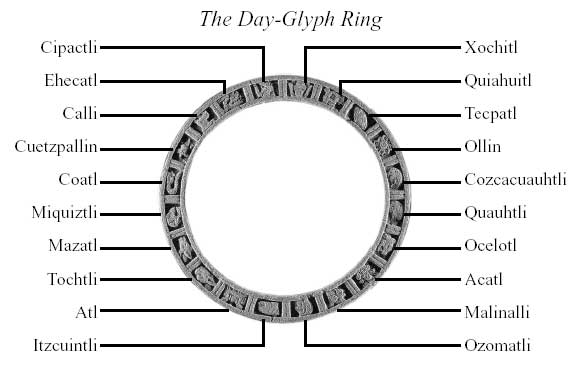 |
There are twenty day glyphs identified in this ring. It should be noted that on the Aztec Calendar, the pointer does not actually point towards a specific glyph, but rather it is aimed between the glyph numbers 1 and 20, as is brought out in the following illustration.
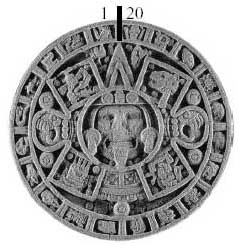 |
At one time it was stated that the calendar year should begin on the day Cipactli (day one), although in distinct cultures it appears that the first day varied. This is congruent, however, with the counter-clockwise movement in reading the Aztec Calendar (whose direction was evidently "clockwise" to the ancient peoples).
| Home | Part: I | Part: II | Part: III | Part: IV | Part: V | Part: VI | Part: VII |
©1995-2011Copyrighted by Charles William Johnson. All Rights Reserved
Reproduction prohibited without written consent of the author.
| Home | Forum | Reviews | Links | Author | Site Map |